Why I'm Publishing This

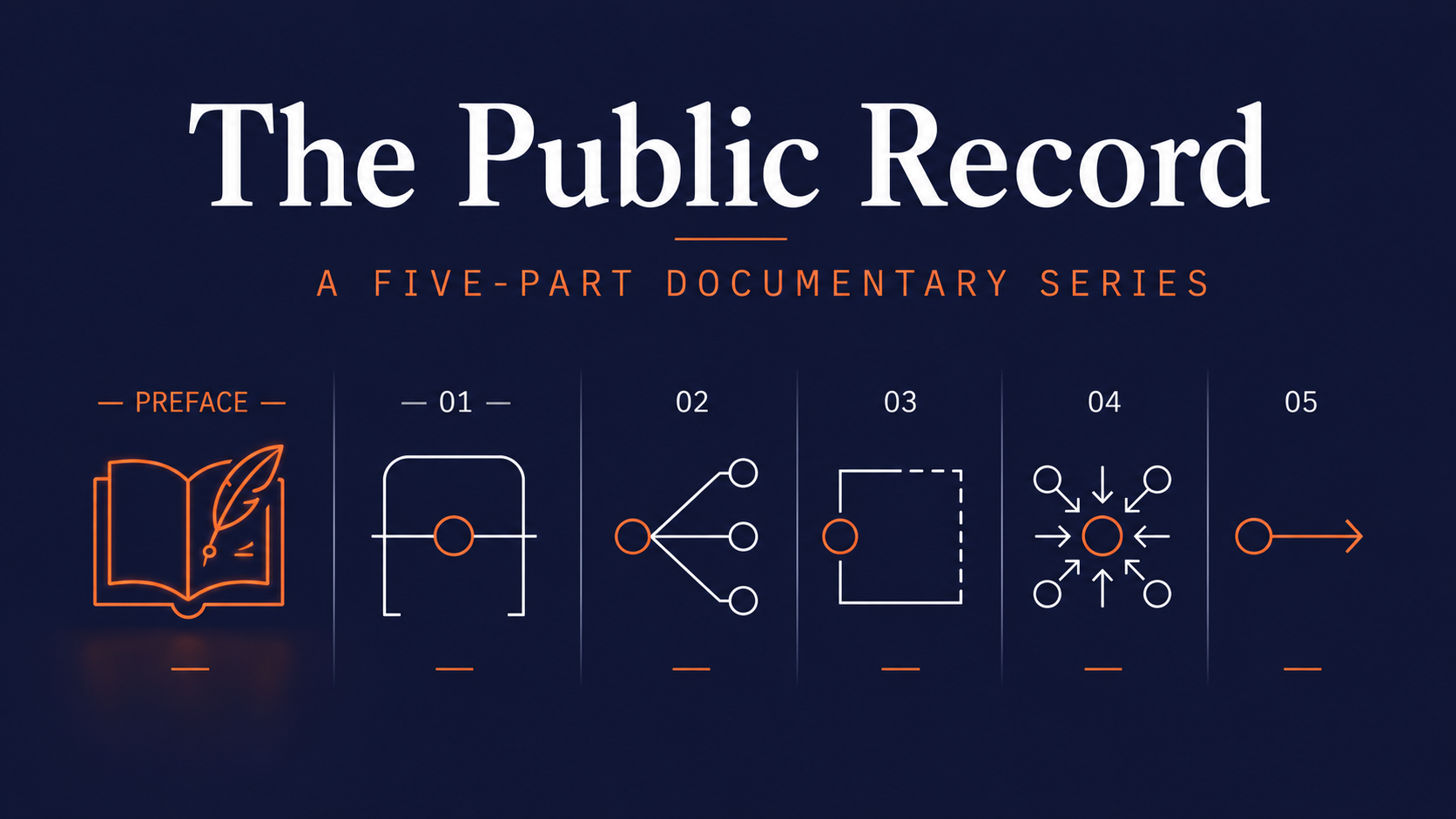
This five-part documentary series documents what happened after a coordination measurement framework was submitted to Canadian federal institutions.
I am Nadia Pulcova, founder and CEO of TalentFund, and the author of the coordination measurement framework at the centre of this investigation. Between October 2025 and August 2026, I submitted it to government departments, parliamentary committees, and public officials. The essays that follow reconstruct what happened from public records, official correspondence, parliamentary proceedings, and access-to-information releases.
I am not a journalist. I am not a government official. I am the person who made the original submission.
Over the nine months since the original submission, I have corresponded with officials across four federal departments — Innovation, Science and Economic Development Canada; the Treasury Board of Canada Secretariat; Public Safety Canada; and Canadian Heritage — filed a sequence of access-to-information requests, received thousands of pages of records, and watched the documentary record expand far past anything I had imagined.
Several requests are now under investigation by the Office of the Information Commissioner of Canada, and additional records continue to be released.
The picture has changed many times.
It continues to change.
I am publishing these articles now — while the investigation is unfolding — because I believe that is the right time to publish, not the wrong one.
The documentary record already contains internal correspondence that I believe should be public. Records that may yet arrive will change what I know. When they do, I will update the record.
This is not a retrospective. It is a series filed mid-investigation.
The public should not have to wait for every investigation to conclude before being able to examine the record that already exists.
Publishing the record while the investigation is unfolding allows others to examine what already exists — before institutions decide what the record means on their own.
The framework measures how well organizations coordinate — one of the invisible layers between institutions that determines whether decisions actually get made when multiple bodies must act together. Every organization measures its outputs. Almost none measure whether coordination between them is functioning at all.
The essays introduce this problem through the cases where the framework was applied — from wildfire response, healthcare handoffs to platform safety — and through the institutional responses that followed. The framework's technical specifications will be published separately, through research papers, patent publications, and future writing.
The articles do not tell the reader what to conclude. They show what the documents show.
They distinguish between what is in the record, what changed my understanding, and what remains under investigation. Where the record is incomplete, I say so.
The first article begins with a letter that arrived on January 7, 2026 — one I assumed, at the time, had been written by the person who signed it. That assumption held for four months.
It is the right place to begin.
I presented this work to government.
I presented it to Parliament.
The questions remain.
I believe the public should now have access to the same record — and what readers conclude from it belongs to them.
The underlying record belongs to everyone.
— Nadia Pulcova
The documentary record described in this series also relates to a civil proceeding that has been commenced against the Crown in the Ontario Superior Court of Justice. That proceeding is a separate matter. These articles are not the case, and the case is not these articles. They form part of an ongoing documentary investigation conducted in good faith by the person who first submitted the work, and they end where the documentary record currently ends, not where the proceeding will end.